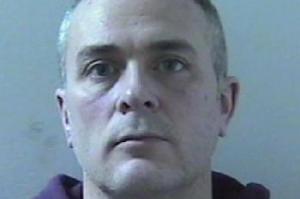
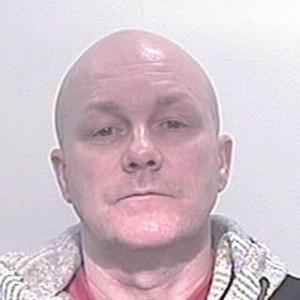
John Docherty
Dunoon
Added to UK Database · Chris Wittwer
August 2014
Schoolgirl Elaine Doyle murder: John Docherty sentenced to 21 years for 1986 killing

The former soldier who murdered Greenock teenager Elaine Doyle more than 28 years ago has been sentenced to a minimum of 21 years in prison.

John Docherty, 50, from Dunoon, Argyll, was convicted of the killing in June.
Elaine’s body was found in a lane close to her parents’ flat in Ardgowan Street in Greenock.
Docherty – who denied the charges – was convicted at the High Court in Edinburgh after DNA evidence came to light.
It brought to a close one of Scotland’s longest running unsolved murders.
The trial, which heard 50 days of evidence, was told how Elaine had attended a disco at Greenock Celtic Club in the town’s Laird Street before she died.
She left with best friend, Lynn McCurdy, now 44, who told the trial how they walked together to a hamburger stall in Greenock town centre.
Around midnight they went their separate ways, with Elaine beginning to walk home.
The court heard how the naked body of the teenager was found in a lane just yards from her home in Ardgowan Street on 2 June 1986. She had been strangled.
Forensic scientist Pauline McSorley told the trial that she had tested DNA that was found on Elaine’s body and clothing.
She said tiny traces matched the DNA of police, forensic scientists, and a member of the laboratory staff.
But two results could not be accounted for until Docherty volunteered a sample of his DNA in May 2012 and gave another sample on March last year, when he was arrested and charged with the murder.
The trial heard that the DNA on Elaine’s back was an exact match. DNA on the girl’s face also matched Docherty’s profile.
Mrs McSorley said it was 560,000 times more likely it came from the accused than any other unrelated male.
Docherty’s defence QC Donald Findlay called witnesses from among 41 other names on police files and attempted to show how someone else could have been responsible.
He also branded the police investigation “a shambles” and said officers had not told the truth and had contaminated the crime scene, meaning the DNA evidence was not reliable.
The eight women and seven men of the jury did not believe Docherty’s defence, however, and convicted him of murder.
The Lord Advocate, Frank Mulholland, said the sentence “ends a long search for justice for the Doyle family”.
He added: “Elaine Doyle was 16 at the time of her death. It deeply touched the people of Inverclyde and beyond who never let her memory fade.
“The support of the public to law enforcement was unwavering and has played a large part in bringing Elaine’s murderer to justice.
“The sterling work of the police officers and prosecutors who worked on the case is reflected in the verdict. Elaine can now rest in peace.
He stripped the terrified girl, or forced her to take off her clothes, in a lane yards from her home in Ardgowan Street, Greenock, on June 2, 1986.
Docherty slipped through the net when detectives apparently simply forgot to question him.
But years later DNA evidence – unknown in crime scene investigations at the time of Elaine’s death – was found on samples taken from her naked body.
Forensic scientist Pauline McSorley said the odds against it belonging to anyone but Docherty were a billion to one, while pathologist Marjorie Turner said evidence pointed to the assailant strangling Elaine from behind.
The majority verdict, after more than four hours, rejected Docherty’s claim that he was at home with his parents in the town’s Anne Street.
The eight women and seven men had heard 52 days of evidence, and hours were spent dealing with the unprecedented defence claim that a list of 41 ‘suspects’ might include the real killer.
Besides Elaine, who had a part-time job as a jeweller’s assistant, and her friends at the Celtic Club disco, was Docherty.
He was with John Faller, who told police Docherty had been with him. Police failed to go straight to Docherty to confirm the story.
As forensic scientists refined techniques for extracting DNA from crime scene samples, they returned to the tape pressed against Elaine’s body in the hope of trapping tell-tale fibres.
Finally, in March 2006, persistence paid off but the microscopic result did not match any likely suspects whose DNA was held on any UK database.
Operation Evergreen was launched and police sought DNA samples from all the men in the investigation files.
By May 2012, they had traced Docherty, an ex-Royal Engineer who had returned to Greenock. He willingly took the mouth swab test that gave police their breakthrough.
Another vital link in the chain came when a key witness, Martin Brown, looked at photos taken to his London home.
Mr Brown, now 52, had described a man with staring, angry eyes he had seen with a girl near Ardgowan Street at around the time Elaine might have been there.
He told detectives in September 2012 a photo, culled from Docherty’s Army ID card, reminded him of the fleeting encounter 26 years earlier.
Docherty did not give evidence but his defence team attacked the police investigation. Even senior officers leading the murder hunt admitted in court there were shortcomings.
The so-called mistakes began with an act of compassion when a police blanket was draped over Elaine to shield her body from onlookers.
Defence QC Donald Findlay claimed the scene had been so contaminated the DNA evidence was not reliable.
Judge Lord Stewart told jurors although they had heard criticism of the early investigation, ‘extraordinary persistence, skill and determination’ had brought the case to court.
He told Docherty the only sentence for murder was life but called for a background report.
Docherty was remanded in custody to await sentencing in Glasgow in August.
As he left court, Elaine’s brother John Doyle, 49, said: ‘The jury returned the right decision. I always knew John Docherty was guilty.’






You must be logged in to post a comment.